The Mayoral Committee has recently approved the 2025 Integrated Public Transport Network (IPTN) for the City of Johannesburg which will form the basis for public transport network investments in the City. “This is a huge milestone for the City of Johannesburg says the City of Johannesburg’s Acting Executive Director, Jeff Ngcobo.
The City of Johannesburg’s population is growing at a rate of 3% per annum. Joburg’s transport network is experiencing unprecedented demand for mobility, without an appropriate public transport network and services this growth trajectory will result in chronic gridlock, rendering the City less liveable. Currently road congestion levels requiring 68% more travel time in the peak are common.
Investing only in road capacity enhancements is neither a viable nor an equitable option because the majority of households in the City do not own cars. Public transport is one of the most effective mechanisms to bring about transformative change in the City. Apart from the fact that most households in the City are completely dependent on public transport, a more focused public transport network can be a catalyst for inclusive spatial transformation.
“The plan departs from approaching public transport service delivery from a supply-driven perspective in which focus is on specific transport modes or operators. On the contrary, the proposed IPTN responds to travel demand and the desired configuration of the City espoused in the spatial development framework (SDF). These are platinum corridors as they will form the basis of public transport network investments in the City”, says Ngcobo.
He adds that “The departure point in developing the IPTN was to ensure that the network is spatially and temporally demand responsive”. The plan has identified twelve (12) corridors but these corridors will not be able to function alone without a supporting secondary network. Log onto www.joburg.org.za to see the map.
Ngcobo says, “We understand that the planning horizon of 2025 is relatively too short for implementing the infrastructure intensive interventions such as rail and BRT however the IPTN primary corridors can be implemented in the interim by making use of agile modes as far as possible by introducing the Integrated Corridor Management.
Implementation of the proposed interim interventions is viewed as a short to medium term approach to stabilising and enhancing the level of service of public transport in high demand corridors in the City as can be seen in the implementation programme summary:
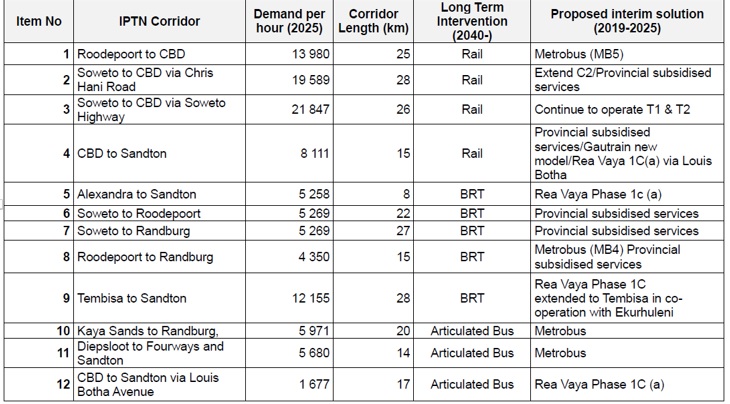
While the City has adopted this IPTN plan it is cognizant of the impact of COVID19 in the livelihoods of its residents and visitors which would have a direct impact on this plan. The City has partnered with the UK Government as part of the Future Cities Programme to analyse the impact of COVID19 on mobility and the extent to which this plan and other policies of the City would have to be reviewed.
Contact Nobuntu Ciko on 071 413 9817 for more information.
Ends
Virgil James
Communications Specialist
City of Joburg
082 467 9415

